A slim 88-key board with Casio’s Scaled Hammer Action II and, unusually at this price, the SP-3 pedal, music rest and power adapter already in the box. Ten sounds rather than hundreds — the money went into the keys.
The bottom line The pragmatic first piano: weighted keys, the pedal in the box, and a depth that lets it live on a desk rather than in the way.
Casio’s CDP line exists to answer one question — how little space and money does a properly weighted 88-key piano need? The CDP-S110 is 99 mm deep and 10.5 kg, which is closer to a controller than to a console piano, and it still carries Scaled Hammer Action II across the full keyboard.
The ten sounds are the trade. An arranger at this price will list hundreds; Casio lists ten and puts the budget into the action and the cabinet. If you want accompaniment styles and a screen, this is the wrong instrument. If you want to practise scales on keys that push back, it is a very direct answer.
What makes it unusually complete is the box: the SP-3 sustain pedal, the music rest and the power adapter are all supplied. Three things that are commonly sold separately, and each of which turns a working keyboard into a frustrating one when it is missing.
Casio also lists a six-AA battery option. That is rare on a hammer-action instrument and worth knowing about if the piano has to move between rooms.
What we like, and what we don't
Strengths
Hammer action across all 88 keys, which is the line that separates a piano from a keyboard
Sustain pedal, music rest and power adapter are included — three purchases most rivals leave to you
99 mm deep and 10.5 kg, so it fits a desk and can be moved by one person
Runs on six AA batteries as well as the mains, which no other piano in this lot offers
Compromises
Ten sounds is a deliberate choice, and it will feel thin if you expected an arranger
Not offered on the US or UK stores at the time of writing
Specifications
Keys
88 weighted, Scaled Hammer Action II
Sounds
10 total (Casio states)
In the box
SP-3 sustain pedal, music rest, power adapter
Connectivity
USB-to-Host
Practice tools
Metronome, transpose, reverb and chorus
Dimensions and weight
1 322 × 232 × 99 mm · 10.5 kg
Battery option
6 × AA, not supplied
Amazon reference
B099R27JRL (identical on 6 markets)
EAN
4971850362609
Questions people actually ask
Is the SP-3 pedal a proper sustain pedal?
It is a footswitch supplied by Casio for this instrument, so polarity is correct out of the box — the failure that makes a keyboard appear to sustain permanently does not arise here.
Can it run without mains power?
Casio lists six AA batteries as an alternative supply. They are not included, and the listing does not state a runtime.
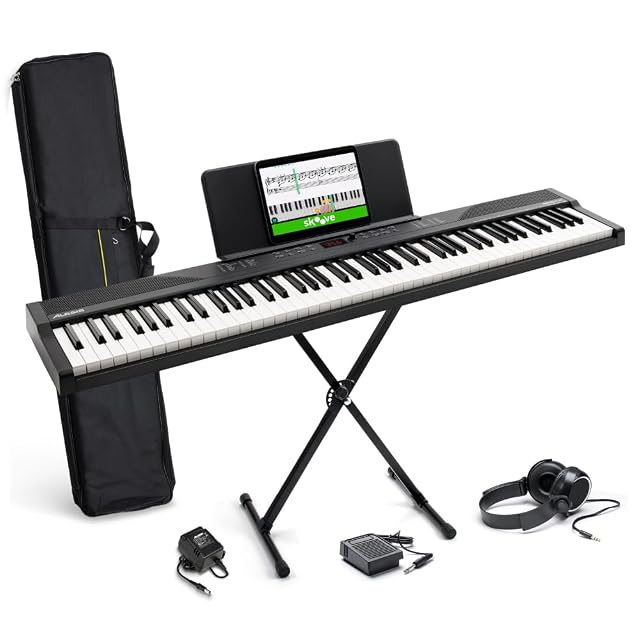
88 touch-sensitive keys · 480 sounds · full accessory bundle
Not a weighted piano and not sold as one: 88 full-size touch-sensitive keys, 480 sounds, and a bundle that includes the stand, pedal, headphones, bag and adapter. The most complete box in this lot.
Best for: A first instrument for someone who is not yet sure they will keep playing.
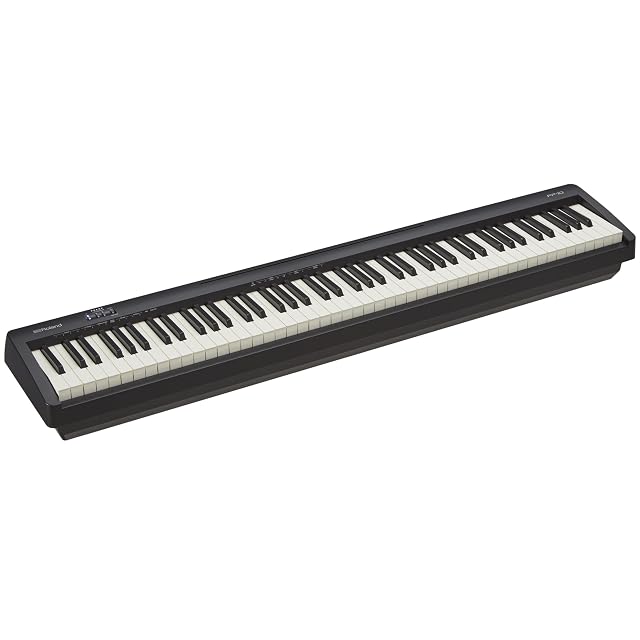
Roland’s entry into the FP series: 88 keys with an ivory-feel surface, the SuperNATURAL engine, and a keyboard mechanism Roland describes as quiet in itself — the detail that decides whether a flat-dweller can practise at night.
Best for: Someone who will practise mostly in headphones and wants the action to be the strong part.
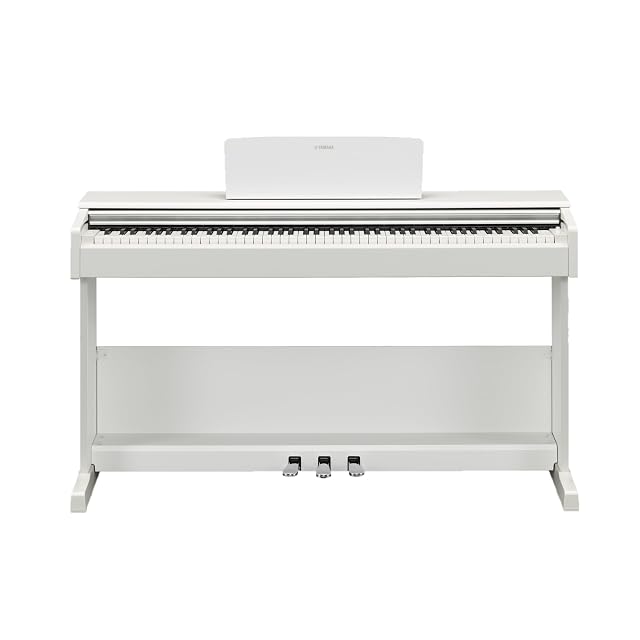
A console piano rather than a portable one: 88 Graded Hammer Standard keys, three pedals and a cabinet that stays where you put it. Yamaha also fits a volume limiter, which sets a ceiling on output.
Best for: A permanent practice piano in a room where it can stay assembled.