A console piano rather than a portable one: 88 Graded Hammer Standard keys, three pedals and a cabinet that stays where you put it. Yamaha also fits a volume limiter, which sets a ceiling on output.
The bottom line The right answer when the piano has a permanent home — and the wrong one if it ever has to be carried.
The ARIUS YDP-105 is the console option in this lot, and that single fact drives everything else. The stand is the instrument, the three pedals are part of the cabinet, and nothing shifts under the hands during a loud passage.
The action is Yamaha’s Graded Hammer Standard: heavier in the bass, lighter in the treble, the way an acoustic piano behaves because of the physical size of its hammers. Yamaha also lists damper resonance modelling, which is what makes the sustain pedal do something more interesting than simply holding notes.
The volume limiter is worth naming because it is unusual on an instrument at this level. Yamaha describes it as a ceiling for output through the speakers or headphones. That is the manufacturer’s description, and this site reports it as such and stops there.
Two practical notes from the price data. There was no US offer when this page was written, and the Spanish price stood well above the German one — enough that it is worth checking your own store before ordering.
What we like, and what we don't
Strengths
Three real pedals in a fixed cabinet — the closest thing here to an acoustic instrument’s layout
Graded hammer action: heavier at the bass end, lighter at the treble, as on a piano
A volume limiter is a genuinely useful setting in a house with children
The cabinet does not move while you play, which no X-frame stand fully achieves
Compromises
It is furniture: it has to be assembled and it does not travel
The most expensive instrument in this lot, and the Spanish price is far above the German one
Not offered on the US store, and no UK offer at the time of writing
Specifications
Keys
88, Graded Hammer Standard (GHS)
Pedals
Three, built into the cabinet
Volume limiter
Yamaha states a maximum output setting
Resonance
Damper resonance modelling (Yamaha states)
In the box
Power adapter, manual, three months of flowkey premium
App
Compatible with Smart Pianist
Amazon reference
B0FTFL84J6 (identical on 5 markets)
EAN
4957812719803
Questions people actually ask
What does the volume limiter do?
Yamaha describes it as a way to define a maximum volume through the speakers or headphones. We report the feature as the manufacturer states it and give no advice about listening levels.
Is this the same as a P-series Yamaha?
No. The P series is portable and takes a separate stand and pedal; the ARIUS YDP line is a console instrument with the stand and three pedals built in.
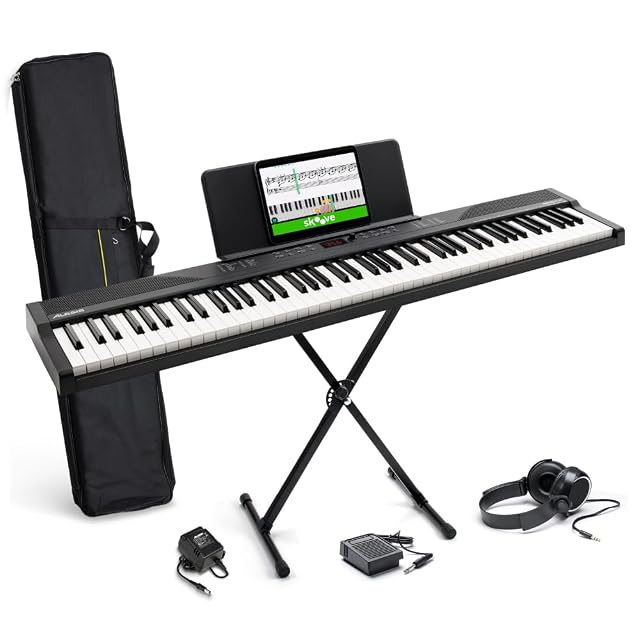
88 touch-sensitive keys · 480 sounds · full accessory bundle
Not a weighted piano and not sold as one: 88 full-size touch-sensitive keys, 480 sounds, and a bundle that includes the stand, pedal, headphones, bag and adapter. The most complete box in this lot.
Best for: A first instrument for someone who is not yet sure they will keep playing.
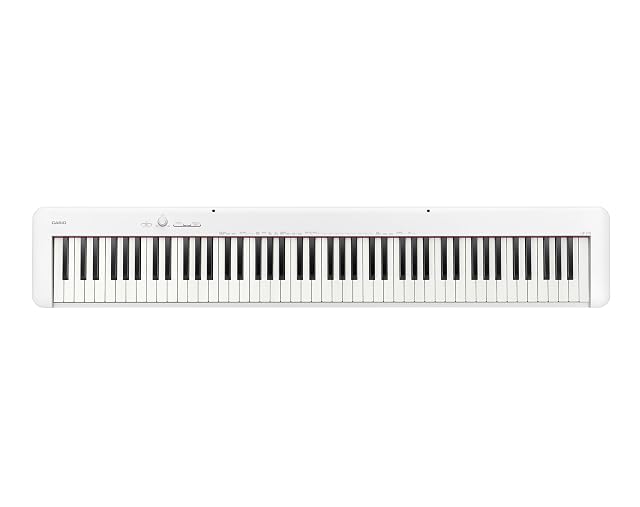
88 weighted keys · 10 sounds · pedal and stand included
A slim 88-key board with Casio’s Scaled Hammer Action II and, unusually at this price, the SP-3 pedal, music rest and power adapter already in the box. Ten sounds rather than hundreds — the money went into the keys.
Best for: A first weighted piano where the pedal and adapter should not be a second order.
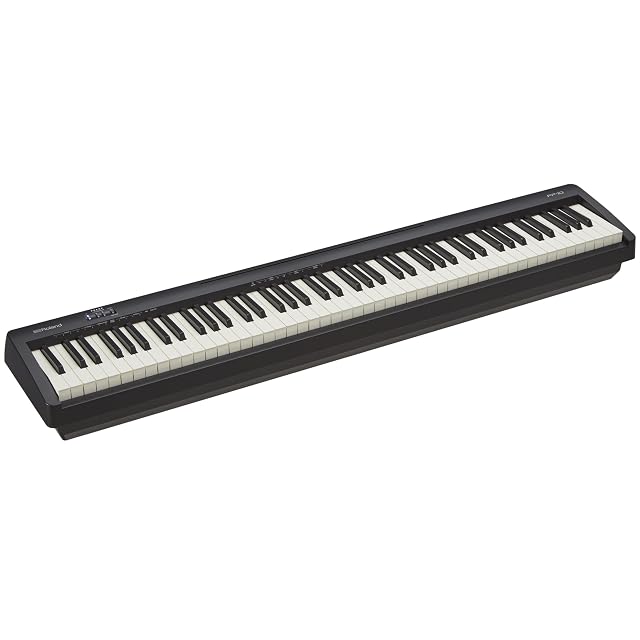
Roland’s entry into the FP series: 88 keys with an ivory-feel surface, the SuperNATURAL engine, and a keyboard mechanism Roland describes as quiet in itself — the detail that decides whether a flat-dweller can practise at night.
Best for: Someone who will practise mostly in headphones and wants the action to be the strong part.